Specialty medicine moves fast, and each field moves differently. For example, a dermatologist might see dozens of patients a day, cycling from mole checks to biopsies in ten-minute blocks. Meanwhile, a cardiologist juggles complex follow-ups, test reviews, and new consults in the same afternoon. Similarly, a urologist might mix procedures with outpatient visits without a break in between. Because of this pace, live scribes in specialty medicine solve a problem every one of these providers shares: there’s no spare time left for charting.
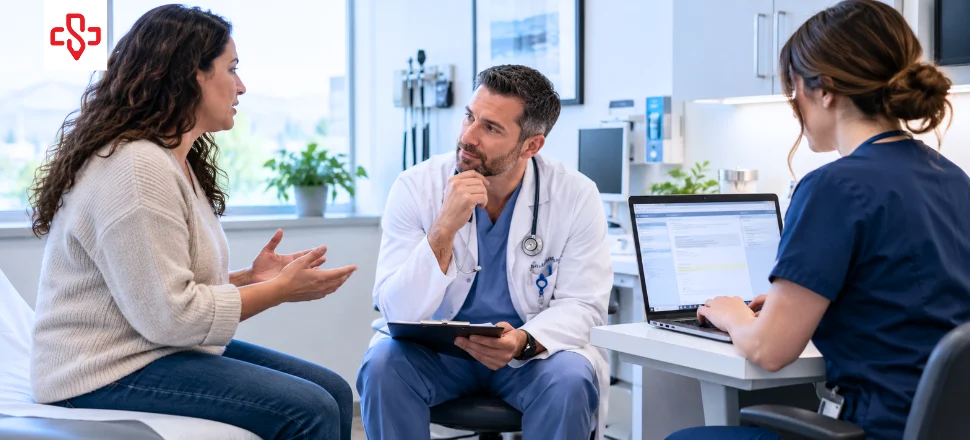
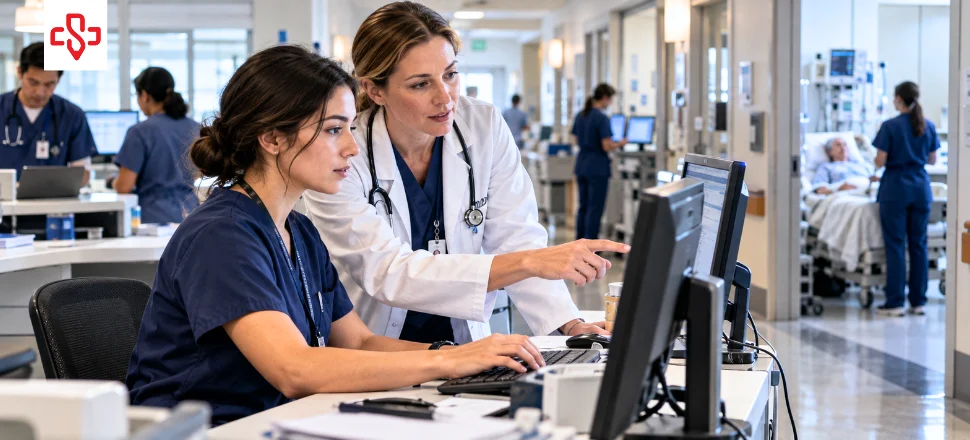
Specifically, by handling EMR tasks in real time, a live scribe lets providers stay focused on the patient in front of them without sacrificing accuracy or compliance. Although emergency departments tend to dominate the scribe conversation, dermatology, cardiology, and urology clinics benefit just as much, and sometimes even more. A dedicated outpatient scribe support may fit a specialty clinic’s specific rhythm even better.
Why Specialty Clinics Need Documentation Support
High patient volumes. Overall, specialists often see patients back-to-back. For instance, research shows dermatology visits average under 15 minutes,1 so even small charting delays snowball into hours of backlog by the end of the day.
Detail-heavy notes. In particular, specialty documentation demands precision. For example, cardiology notes carry test interpretations and medication adjustments, while dermatology notes need lesion mapping and procedure detail. As a result, scribes trained in these workflows keep accuracy high without slowing the clinic down.
Reimbursement at risk. Additionally, specialty billing codes are unforgiving. Because a missing detail can trigger downcoding or an outright claim denial, a scribe who knows what each note requires protects that revenue.
Dermatology: Efficiency Without Compromise
Since dermatologists carry some of the highest patient volumes in medicine, a missed detail, such as the exact size or location of a lesion, can affect both compliance and continuity of care.
- First, findings get recorded during the exam itself, not from memory afterward.
- Next, procedures such as biopsies or cryotherapy are documented as they happen.
- Finally, follow-up instructions are captured accurately the first time.
As a result, instead of finishing notes late into the evening, dermatologists close out the day with a completed chart.
Cardiology: Managing Complexity at Scale
Because cardiologists track patient histories that span years, EKG interpretations, medication changes, and test results pile up quickly if left for later. To address this, a scribe helps by documenting provider impressions during the visit, recording results and treatment changes in real time, and keeping data organized across repeat visits. Consequently, that continuity matters most in a specialty where a missed detail today can complicate a decision a year from now.
Urology and Other Specialties: Precision Matters
In urology and similar fields, procedures and outpatient visits often fall on the same schedule, so providers can’t afford to choose between charting well and moving quickly. Instead, live scribes keep procedure notes complete and compliant, keep the EMR current in real time, and let providers hold their pace without cutting corners. Ultimately, for specialties built around precision, that combination of speed and accuracy is the whole point.
Specialty Documentation Challenges at a Glance
Overall, the table below summarizes how documentation pressure differs by specialty and where a live scribe makes the biggest difference.
| Specialty | Primary Documentation Challenge | How a Live Scribe Helps |
|---|---|---|
| Dermatology | High patient volume, short visit windows | Real-time lesion and procedure notes |
| Cardiology | Complex, multi-year patient histories | Live tracking of test results and treatment changes |
| Urology | Procedures mixed with outpatient visits | Compliant procedure notes without workflow delays |
| General Specialty Care | Detail-sensitive billing codes | Complete documentation that protects reimbursement |
Why On-Site Scribes Outperform Remote Options
Some practices consider telescribing to cut costs, and remote models can work in certain settings. However, in specialty care, they often fall short.
- Nonverbal cues get missed. For example, a dermatologist pointing to a lesion or a cardiologist reviewing imaging silently loses meaning over a screen.
- Quick clarifications disappear. Specifically, providers can signal an in-room scribe with shorthand or a gesture, and that’s not possible remotely.
- Workflow integration suffers. Over time, on-site scribes become part of the clinical team and build trust with providers and staff.
Therefore, for high-volume specialties, an on-site presence tends to be the more reliable choice. In fact, larger health systems often extend this coverage using shared scribe pools, which lets even small specialty clinics tap into the same on-site support model.
The ROI for Specialty Practices
Because EMR tasks are off their plate, providers move through visits faster and can often fit in additional patients per day. In addition, detailed, accurate notes mean claims get coded correctly and reimbursed on time. Furthermore, fewer after-hours charting sessions mean less burnout, which keeps providers engaged and less likely to leave the practice altogether. Even one- or two-provider clinics see this benefit, particularly when they sit near hospital systems already running hospital scribe services.
Compliance and Quality Assurance
Because specialty care sits under close payer and regulatory scrutiny, detailed documentation is the main safeguard against audits. To support this, a scribe captures every required detail during the encounter, standardizes notes across providers in a clinic or system, and keeps documentation aligned with coding and compliance rules. As a result, that consistency protects both the individual provider and the practice as a whole.
The Patient Experience: Less Screen Time, More Face Time
When a specialist spends more time typing than talking, patients notice, and trust suffers. Instead, a scribe frees the provider to make eye contact, explain results clearly, and spend the visit listening rather than clicking through screens. In fact, research on scribe-supported practices backs this up: one study found that adding a scribe improved several measures of documentation quality and clinical efficiency, and notably, it did so without requiring providers to see more patients to justify the cost.
Precision Care, Powered by Scribes
Overall, from dermatology to cardiology and beyond, specialty medicine runs on precision and pace in equal measure. When EMR demands slow that down, accuracy and provider well-being both take the hit. However, live scribes in specialty medicine close that gap by documenting in real time, keeping patient flow moving, protecting compliance and revenue, and letting providers focus on care instead of clicks.
For practices weighing on-site support against remote alternatives, our virtual scribe services page offers a direct comparison. Ultimately, in high-volume specialty settings, scribes aren’t a nice-to-have; they’re the difference between a clinic that keeps pace and one that falls behind. To that end, Scribeology builds scribe teams around exactly this kind of specialty workflow, matched to the pace and detail each practice needs.