
Clinical quality builds through accurate documentation. Specifically, a complete history, a clearly recorded assessment, a discharge note that captures what the physician decided — these details protect patients. When they slip, care continuity suffers and outcomes decline. In fact, medical scribes and patient outcomes are directly connected, and that connection shows up at every level of care delivery. This post breaks down exactly how.
The Documentation Burden Hurting Patient Care
Physicians in the United States spend close to two hours on administrative work for every hour of direct patient care. In particular, EHR documentation consumes most of that time. Physicians often complete it after hours, away from the patient. When charting gets deferred, it becomes a memory reconstruction — not a real-time clinical record.
The consequences are serious. Delayed or incomplete notes lead to medication errors, missed diagnoses, and failed hand-offs. In addition, billing teams work from records that don’t capture the full complexity of care. Value-based contracts and accreditation standards demand accurate, structured documentation. Unfortunately, rushed end-of-day charting rarely delivers it.
As Stanford professor Dr. Abraham Verghese put it: “The EHR has turned the physician into the highest-paid clerical worker in the hospital.”
Medical scribes exist to fix exactly that.
How Medical Scribes and Patient Outcomes Connect at the Point of Care
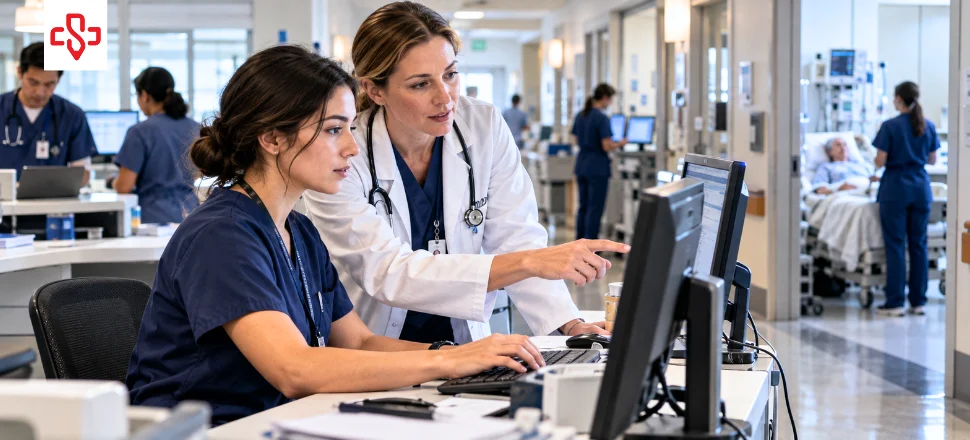
A trained medical scribe documents patient encounters in real time. For instance, they capture history, physical exam findings, provider reasoning, and care plans as the visit unfolds. As a result, this raises documentation quality — and raises the quality of the visit itself.
When physicians stop typing during appointments, they give patients their full attention. As a result, they maintain eye contact and listen actively. Instead of managing a screen, they notice details they might otherwise miss — a hesitation before answering, a briefly mentioned symptom, a concern the patient was reluctant to raise. Those details shape diagnosis and treatment.
Furthermore, notes completed during or right after the encounter are more accurate than those written hours later. Our medical scribes capture clinical dialogue precisely, using correct medical terminology and structuring notes to match each provider’s format. The record reflects what actually happened — not a summary assembled from fading recollections.
Beyond accuracy, complete documentation also captures clinical reasoning. It records what the physician considered and ruled out, why they chose a specific treatment, and what follow-up they ordered. Consequently, that level of detail supports care continuity and reduces errors when another provider steps in.
The Effect on Care Teams and Patient Safety
Documentation quality ripples through every layer of a care team. Accurate, complete records let nurses act on orders with confidence. Similarly, specialists get the context they need to make informed decisions. Meanwhile, case managers coordinate follow-up without chasing missing information, and pharmacists verify medication plans against clearly documented findings.
Hand-offs are one of the highest-risk moments in healthcare. They depend entirely on the quality of the record being passed. As a result, a complete note reduces the chance that something critical gets missed at shift change, during transfer, or at discharge. When the record is fragmented, however, care teams fill gaps with assumptions — and assumptions cause errors. Strong documentation eliminates that risk.
This matters most in high-volume environments. In the emergency department, the pace and complexity of encounters make real-time documentation essential. Emergency department scribes keep pace with high-acuity workflows. They maintain accuracy throughout each visit and directly reduce delays in care.
The Impact on Billing, Compliance, and Quality Reporting
Accurate documentation also protects revenue and compliance. Evaluation and management (E/M) coding requires records that reflect the full complexity of each clinical decision. Incomplete notes lead to claim denials, undercoding, and audit exposure. Our scribes train on E/M documentation requirements, HIPAA standards, and payer-specific rules. Each record they produce supports the level of care delivered. Practices stop leaving revenue on the table.
For health systems under value-based contracts, the stakes rise even further. HEDIS measures, MIPS scores, and patient experience ratings all rely on documentation accuracy. Poor records mean poor scores — even when the clinical care itself was excellent. Specialty practices feel this pressure acutely. In cardiology, for example, procedure notes, stress test interpretations, and chronic disease management plans all demand targeted, precise documentation. Therefore, a scribe with the right specialty training makes that possible.
What Sets Our Scribes Apart
Not all scribes deliver the same results. Our scribes complete specialty-specific training before their first shift and receive ongoing education as EHR platforms evolve. Moreover, we support Epic, Cerner, athenahealth, eClinicalWorks, and other major systems, matching scribes to providers by specialty and setting.
In addition, we build long-term scribe-provider pairings. A scribe who works alongside the same physician for months learns their documentation style, anticipates workflow needs, and needs fewer clarifications mid-visit. That continuity means faster, more accurate notes and a better experience for both provider and patient. Ultimately, strong results start with strong scribe training, backed by regular audits, provider feedback loops, and ongoing compliance monitoring.
Ready to Improve Medical Scribes and Patient Outcomes at Your Practice?
Ultimately, the link between medical scribes and patient outcomes runs through every part of care delivery. Accurate records. Attentive providers. Reliable hand-offs. Clean billing. When documentation works, care gets safer, faster, and more focused on the patient. In short, every provider who sheds the documentation burden gets something valuable back — the ability to practice medicine the way they trained to.
Contact Scribe.ology today for a customized consultation. We offer both in-person and virtual medical scribes tailored to your setting, specialty, and workflow.