Healthcare documentation has never been more demanding. Physicians must deliver excellent patient care. At the same time, they must keep up with compliance rules, complex EHR systems, and evolving documentation standards. That is why medical scribe training is one of the most valuable investments a healthcare organization can make. Well-trained scribes do more than take notes. They become trusted members of the care team from day one.
This guide is for aspiring scribes and practice owners alike. It walks through what the training involves and what each part delivers.
Why Medical Scribe Training Can’t Be an Afterthought
Scribes work in high-stakes environments. One documentation error can affect a diagnosis, disrupt billing, or break care continuity. Incomplete notes also drive revenue leakage for many practices.
Many programs offer a quick orientation and then send new hires into the deep end. Strong training works differently. It is layered, structured, and grounded in real clinical complexity. It prepares scribes for what happens when a physician steps into an exam room, not for textbook scenarios.
What Strong Medical Scribe Training Covers
Foundational Medical Knowledge
Every candidate starts with the fundamentals. Before touching an EHR, trainees build working knowledge of anatomy, physiology, and medical terminology. They also study pharmacology basics and clinical documentation structure. This foundation is required, not optional. Without it, a scribe simply transcribes words. With it, a scribe understands what they are documenting and why it matters.
EHR System Mastery
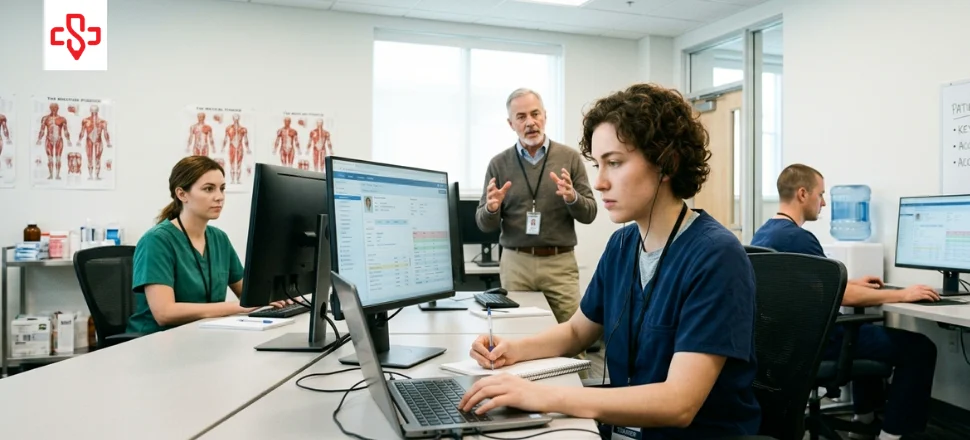
Electronic health records are the backbone of modern documentation. Trainees learn widely used platforms, including Epic, Cerner, and Athenahealth, through hands-on simulations. They learn more than where to click. They also learn to document efficiently, match provider preferences, and stay accurate under time pressure. Speed matters here, because a scribe who slows a physician down defeats the purpose of the role. For a closer comparison, see how scribes stack up against EHR optimization tools.
Specialty-Specific Modules
Workflows differ sharply by specialty. A cardiology note is structured differently than a pediatric well visit. Likewise, an emergency department encounter moves much faster than a behavioral health session. For that reason, training modules should cover cardiology, pediatrics, emergency medicine, outpatient primary care, and behavioral health. As a result, scribes arrive already familiar with the terminology, note formats, and rhythms of their setting.
HIPAA and Compliance
Scribes handle sensitive health information every day. Because of this, every trainee should complete thorough modules on HIPAA, patient confidentiality, and ethical documentation. AHIMA sets authoritative standards for the industry, so aligning compliance training with its guidance is a smart move. In short, compliance is a core professional value, not a formality.
Soft Skills and Clinical Communication
Technical knowledge alone does not make a great scribe. A scribe who can navigate Epic but cannot read a room will still struggle. Therefore, training should build active listening so trainees catch clinical nuance. It should also teach them to adapt to different care settings, accept feedback constructively, and communicate professionally with providers at every level. Together, these skills separate a good scribe from an exceptional one.
Technology-Enabled Learning for the Modern Scribe
Modern medical scribe training reflects how people learn today. Candidates use mobile-friendly modules, AI-supported assessments, and interactive case studies that mirror real clinical situations. Real-time feedback dashboards also help trainees track progress and spot gaps.
Additionally, virtual medical scribes need extra modules on remote professionalism, home office setup, and telehealth documentation etiquette. That way, training builds clinical readiness in any location.
Mentorship and Ongoing Development After Onboarding
Training does not end on the first day in the field. Instead, scribes enter an ongoing development structure. It includes mentorship pairings with experienced scribes and shadowing across care settings. Monthly webinars and case study reviews build judgment using real documentation scenarios.
Provider feedback flows back to scribes through quality assurance. This process supports growth rather than penalizing errors, so every encounter becomes a chance to improve.
What a Fully Trained Scribe Looks Like
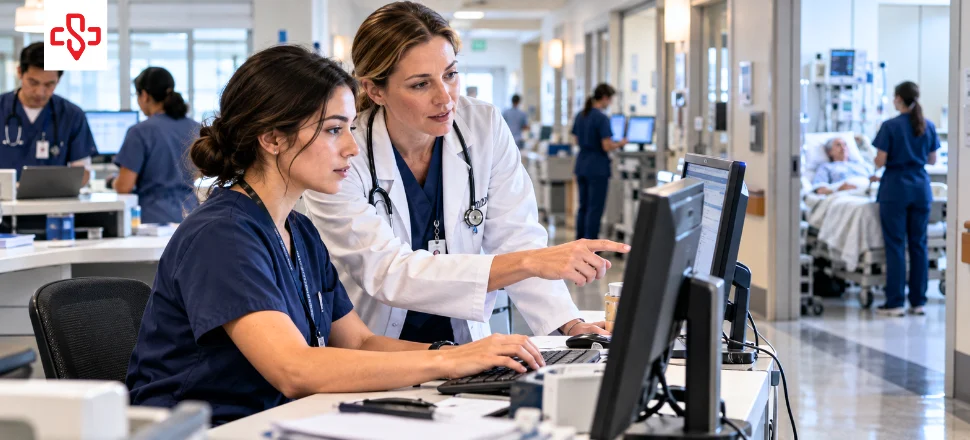
A fully trained scribe contributes from day one. They document encounters with precision and understand the workflow of their care environment. They also anticipate provider needs and carry themselves with the professionalism that patients and physicians expect.
For many scribes, the role is an early step toward medicine, nursing, or healthcare operations. Those interested can browse open roles on our careers page. The clinical exposure builds confidence and strengthens future applications to healthcare programs. Still, none of this happens by accident. It starts with medical scribe training that takes the role seriously.
Ready to Work With Scribes Trained to Perform?
If documentation burden or administrative tasks are costing your practice time, Scribe.ology’s trained scribes can help. Our program builds professionals ready for real clinical environments, not just orientations. Request a complimentary consultation to see how we can support your team from the very first shift.