
In-person scribes vs remote scribes is a decision that shapes clinical outcomes far beyond documentation alone. Electronic health records, regulatory compliance, and detailed charting expectations now consume hours that physicians would rather spend with patients. Many organizations have turned to medical scribes to reclaim that lost time, but the choice between on-site and remote support carries real consequences for clinical quality and day-to-day operations.
A medical scribe handles real-time charting during patient encounters, and this role has evolved into a strategic operational asset that affects throughput, revenue integrity, and clinician satisfaction. While remote scribing has gained traction for its flexibility, a growing number of practices choose in-person scribes because of the tangible advantages they deliver every day in the exam room.
How In-Person and Remote Scribing Models Differ
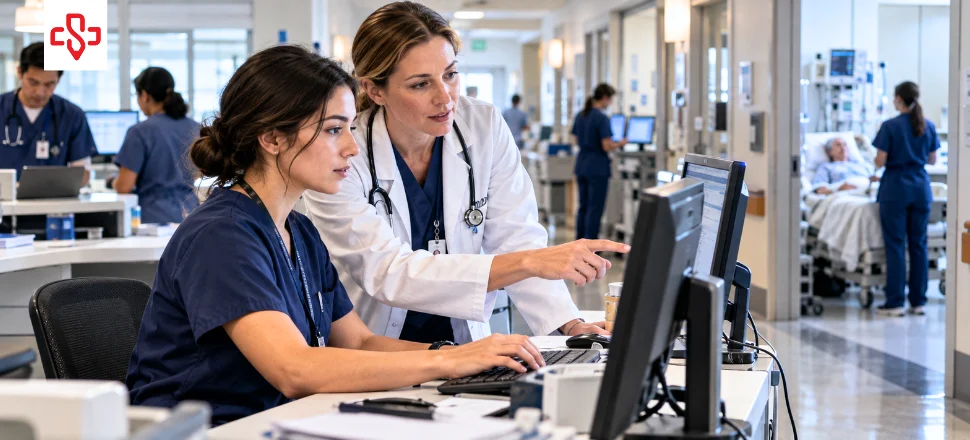
Both scribing models aim to reduce the documentation workload on clinicians, but they operate in fundamentally different ways. An in-person scribe sits in the exam room during each patient visit. They observe physical exams, listen to clinical conversations, and enter notes directly into the EHR in real time. A virtual medical scribe, on the other hand, works from a remote location and relies on audio or video feeds to capture encounter details. The table below highlights the key differences between the two models.
| Factor | In-Person Scribes | Remote Scribes |
|---|---|---|
| Clinical Observation | Full visual and verbal access to the encounter | Limited to audio or video feed |
| Communication | Instant, natural, face-to-face | Requires verbal cues or follow-up messages |
| Technology Dependence | Minimal — works within the physical environment | High — relies on stable internet and platforms |
| High-Acuity Readiness | Moves room to room with the provider | Struggles in fast-paced, unpredictable settings |
| Team Integration | Embedded member of the care team over time | Slower to build rapport and learn workflows |
| Documentation Accuracy | Captures nonverbal cues, exam findings, context | May miss nuances not conveyed through audio |
| Best Suited For | EDs, hospitals, specialty clinics, high-volume practices | Telehealth, low-acuity scheduled visits |
Real-Time Observation Produces Better Documentation
One of the strongest arguments for in-person scribes vs remote scribes is their ability to capture the full clinical picture. A physically present scribe observes nonverbal cues, body language, and exam findings that audio-only connections cannot convey. Research has shown that scribes improve physician satisfaction with chart accuracy and increase the likelihood of closing notes within 48 hours. These outcomes stem from contextual awareness that only comes from being in the room.
Seamless Communication Without Workflow Disruption
Face-to-face interaction between a provider and a scribe feels natural and efficient. A physician can glance at the scribe, clarify a finding, or request a quick edit without breaking the conversational flow with the patient. Remote scribing often requires deliberate verbal cues or follow-up messages, and the friction slows down busy clinics. Practices that handle high patient volumes find that live scribes in high-acuity care settings deliver responsiveness that remote models cannot match.
No Dependence on Technology Infrastructure
Remote scribing depends on stable internet, clear audio, and secure platforms. A dropped connection during a critical encounter can mean incomplete documentation or delayed chart closure. In-person scribes eliminate these risks entirely by working within the physical clinical environment, unaffected by bandwidth issues or platform outages.
Stronger Performance in Fast-Paced Clinical Settings
Emergency departments, trauma centers, and surgical practices operate at a pace that demands instant adaptability. In-person scribes follow clinicians from room to room, adjust to shifting priorities, and document complex cases as they unfold. Remote scribes may perform adequately in scheduled visits but often fall behind in high-intensity environments. Organizations that prioritize emergency department scribing consistently choose on-site support for their busiest units.
Deeper Integration With the Clinical Team
Physical presence allows in-person scribes to become embedded members of the care team. Over time, they learn provider preferences, specialty terminology, and workflow patterns. This familiarity improves coordination with nurses and staff, and the scribe anticipates documentation needs before they arise. Remote scribes take significantly longer to achieve that depth of integration.
Better Accuracy Supports Compliance and Revenue
Accurate clinical documentation is the foundation of proper coding, billing integrity, and legal protection. A scribe who directly observes an encounter produces notes that reflect the true complexity of care delivered. This accuracy reduces claim denials, supports appropriate reimbursement, and lowers audit risk. For high-volume practices, the financial impact of improved documentation accuracy is substantial.
Measurable Impact on Provider Burnout and Retention
Administrative overload remains a leading cause of physician burnout. In-person scribes handle documentation in real time, so providers leave work with completed notes. Many doctors who use medical scribes report improved morale, greater job satisfaction, and stronger focus on patient relationships. These retention benefits carry significant long-term value for organizations facing staffing challenges.
Evaluating Total Value Beyond Hourly Cost
Remote scribing is often marketed as the more affordable option. However, in-person scribes drive higher patient throughput, reduce documentation errors, and support provider retention. When practices evaluate total return on investment, on-site scribes frequently deliver greater overall value.
When Remote Scribes Still Make Sense
Remote scribing is not without merit. Practices that operate through telehealth or manage low-acuity scheduled visits can benefit from virtual scribes in the post-telehealth era. The key is matching the scribing model to the clinical environment.
Partner With Scribe.ology for On-Site Scribing Excellence
For practices that demand reliable, high-quality documentation support, Scribe.ology delivers tailored solutions built for real-world clinical demands. With experienced professionals trained across specialties and a deep understanding of hospital scribing workflows, Scribe.ology helps providers reduce administrative burden, improve chart quality, and focus on what matters most. If your organization is evaluating in-person scribes vs remote scribes, the answer starts with a partner that understands both models and knows where on-site support excels.