Telehealth didn’t just survive the pandemic — it became a permanent layer of American healthcare delivery. Patients now expect virtual visit options as a baseline, not a bonus. As telehealth adoption continues to grow, virtual scribes in telehealth have become an increasingly valuable support resource for providers. However, as rapid adoption gave way to routine operations, one problem refused to go away: clinical documentation was still consuming providers at an unsustainable rate.
For practices running hybrid care models, virtual medical scribes have moved from a convenient add-on to one of the highest-leverage operational investments available. Here is why the case is stronger now than it has ever been.
Telehealth Is Permanent — and Documentation Complexity Came With It
Telehealth utilization has stabilized at dramatically higher levels than pre-pandemic baselines. Behavioral health, chronic disease management, and rural care access have all been fundamentally reshaped by remote visits. That momentum is not reversing.
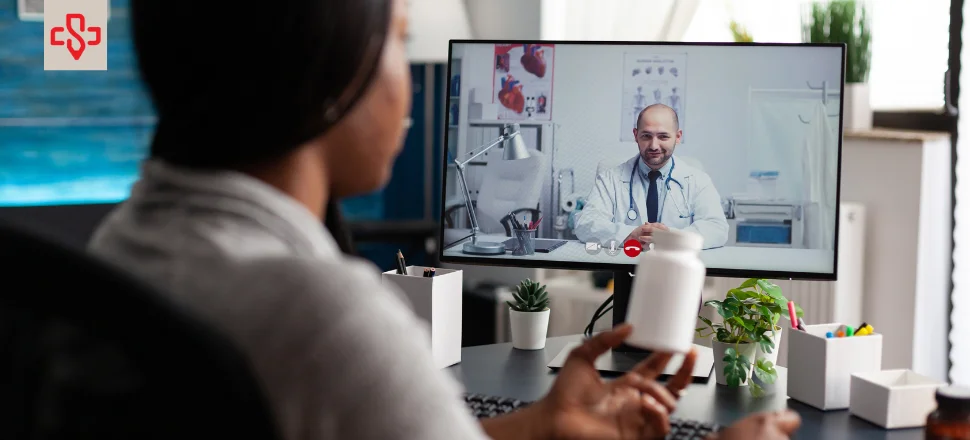
What came with it was documentation friction that traditional clinical workflows were never built to handle. Providers are now navigating multiple platforms — Zoom, Doxy.me, Epic’s integrated telehealth module, and proprietary systems — while maintaining patient engagement, managing technical issues, and generating accurate clinical notes at the same time. Something gives. Usually, it is note quality or provider well-being.
Telehealth did not reduce documentation burden — it relocated and, in many cases, amplified it. Providers running 20 or more virtual visits per day are often charting well into the evening. Virtual scribes eliminate that backlog in real time, not at the end of the shift.
What Virtual Scribes Actually Do During a Telehealth Visit
Many providers assume virtual scribes are simply note-takers. The role is more precise than that. A trained virtual scribe joins each telehealth session as a silent observer. While the provider focuses entirely on the patient, the scribe is actively:
- Documenting in real time inside the EHR — HPI, ROS, physical exam findings, assessment, and plan captured as the conversation unfolds, not reconstructed from memory afterward.
- Flagging discrepancies before the visit closes — If a patient contradicts a prior note or a medication name is unclear, the scribe flags it immediately for provider review.
- Handling order entry and referral documentation — Routine tasks that pull provider attention away from the patient are managed concurrently, not sequentially.
- Delivering a provider-ready note at visit close — A finalized draft is waiting for sign-off by the time the encounter ends, typically within minutes.
For practices already working to improve EHR efficiency, integrating a virtual scribe into telehealth workflows is the natural next step — and often produces the fastest, most measurable ROI of any documentation intervention.
Four Reasons This Model Works in a Mature Telehealth Environment
1. Documentation Drives Burnout — and Burnout Is a Revenue Problem
Physician burnout is not an abstract metric. When providers leave, patient panels fracture, care continuity breaks down, and recruitment costs escalate. Research consistently identifies administrative burden — charting above all else — as the leading driver of burnout. Virtual scribes in telehealth attack that root cause directly, not symptomatically. Practices that address documentation overload protect both provider well-being and long-term retention.
2. Rural and Underserved Providers Finally Have Access to Documentation Support
Onsite scribes are not a realistic option for a solo practitioner in a rural county or a lean FQHC. Virtual scribes change that equation entirely. Location is irrelevant — a provider in rural West Texas receives the same documentation support as a multi-physician group in Dallas, because the scribe is remote by design. When providers are not drowning in charting, they can see more patients. For underserved populations dependent on telehealth for primary care, that expanded capacity has real clinical consequences.
3. Hybrid Care Models Need Scalable Documentation Infrastructure
Health systems and outpatient groups cannot rely on patchwork documentation solutions. Some days are heavy with telehealth visits; others shift back to in-person care. Scribeology’s scribe services are built to flex with volume — scaling coverage during high-demand periods without the overhead of hiring, onboarding, and managing permanent staff. For multi-specialty networks, that scalability is the difference between documentation as a chronic problem and documentation as a solved operational variable.
4. Note Quality Directly Affects Billing Accuracy and Audit Risk
In telehealth, the absence of a physical exam means clinical notes carry more evidentiary weight, not less. Payers scrutinize telehealth claims more aggressively than in-person visits. Incomplete or inconsistent documentation is a billing liability and a compliance risk. Virtual scribes trained in telehealth workflows produce notes that are specific, defensible, and compliant — reducing denial rates and audit exposure simultaneously. Documentation is not just a provider experience issue. Every incomplete note is a potential claim denial. Virtual scribes close that gap visit by visit.
What Separates Purpose-Built Virtual Scribes From Workarounds
Not all scribe solutions are equal. Adapting an in-person scribe model for telehealth often produces friction rather than efficiency. Scribeology’s virtual scribe program was designed for remote clinical environments from the start. That means HIPAA-certified onboarding with encrypted tools and strict remote access protocols, EHR fluency across Epic, Athenahealth, eClinicalWorks, and other major platforms, audio-only visit competency for phone-based telehealth, and multi-specialty training so scribes understand the clinical language of each discipline they support.
Understanding what medical scribe training involves makes the performance difference easier to see. Scribes trained specifically for telehealth documentation are not just faster — they are more accurate and more consistent across visit types and specialties.
On AI Documentation Tools: The Human Layer Still Matters
Ambient AI documentation tools that auto-generate notes from recorded audio are a legitimate and evolving category. Several platforms have shown promising early results. But the honest clinical reality is that AI-generated notes still require human review, still miss contextual nuance, and still struggle with complex multi-problem visits.
Virtual scribes offer contextual judgment that automated tools cannot replicate. They catch contradictions between what a patient says and what the chart shows. They adapt in real time to a provider’s documentation preferences. Many practices are using both — AI for routine, clean visits and scribes for complex cases, high-volume days, or specialties where documentation nuance is highest. That hybrid approach often produces better outcomes than either solution alone.
The Business Case Is Straightforward
When practices evaluate virtual scribes against their actual documentation costs, the math tends to be clear. Providers recover one to two hours of daily charting time. Patient visit capacity increases proportionally. Billing accuracy improves, reducing denial rates. Provider satisfaction increases, improving retention. Overhead stays flat — no hiring, benefits, or office space required.
For a deeper look at how documentation support drives measurable financial outcomes, see how medical scribes improve revenue cycle performance. For practices committed to making hybrid care sustainable — not just functional — virtual scribes in telehealth belong in the operational model, not the experimental budget.
Ready to Solve Your Telehealth Documentation Problem?
Scribe.ology’s virtual scribes integrate directly into your telehealth workflow — no disruption, no ramp-up lag, just clean, accurate notes from day one. Get a Complimentary Consultation